What Are Thyristor Power Controllers and How Do They Work?
Learn what thyristor power controllers are, how they work, and when to use burst fire vs phase angle control in industrial heating applications.
Table of Contents
Industrial heating processes demand tight temperature regulation and high reliability. For example, extrusion lines, annealing furnaces, packaging sealers, and air handling units require precise electrical power control. Without it, product quality drops and energy costs rise.
Traditionally, engineers relied on electromechanical contactors to switch these loads. However, mechanical devices switch slowly. Consequently, they cause thermal fatigue on heating elements and wear out quickly through electrical arcing.
Thyristor power controllers provide a solid-state solution. Because they use semiconductors with zero moving parts, they modulate power across fractions of an AC cycle. As a result, they eliminate contact wear, reduce element fatigue, and deliver smooth process control.
Whether you are designing a new control panel or upgrading an older system, understanding these devices is essential. This guide explains how thyristor power controllers operate, how they compare to contactors, and how to choose the right firing mode for your equipment.
What Is a Thyristor Power Controller?
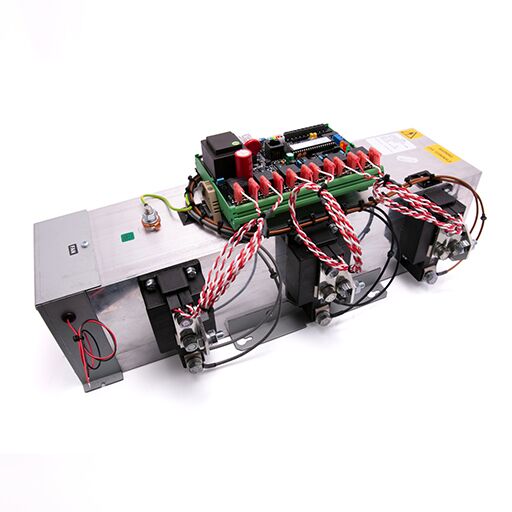
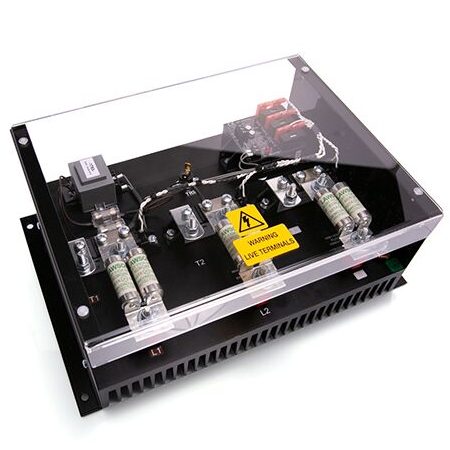
A thyristor power controller is a solid-state device that regulates AC electrical power to industrial heating loads. Engineers often call them Silicon Controlled Rectifiers (SCRs) or thyristor stacks.
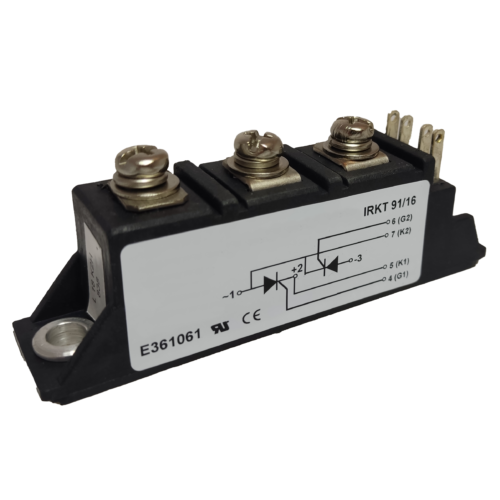
At the heart of the unit sits a four-layer semiconductor. Unlike a mechanical relay, a thyristor switches on in microseconds when it receives an electrical gate trigger. Furthermore, it contains no physical contacts. Therefore, it can switch millions of times without contact pitting, welding, or mechanical degradation.
Standard industrial controllers connect two thyristors in an inverse-parallel (back-to-back) arrangement. This layout allows the controller to regulate both halves of the AC sine wave. Consequently, manufacturers build them in single-phase (230V) and three-phase (415V) configurations for industrial use.
How Do Thyristor Power Controllers Work?
Thyristor controllers regulate the electrical energy delivered to a load by controlling when and how the semiconductor conducts during the AC sine wave cycle. The controller receives an analogue or digital control input from a temperature controller, PLC, or external potentiometer (such as 0–10V DC, 4–20mA, or RS485 Modbus) and translates that command into gate firing pulses.
Thyristor power regulation operates primarily via two switching methods:
In burst firing mode, the controller switches full AC sine waves on and off at the exact point where AC voltage crosses zero volts.
The Cycle: Power is modulated by altering the ratio of complete conduction cycles to non-conduction cycles over a given timebase (e.g. 50 cycles on, 50 cycles off equals 50% average power).
Grid & EMC Considerations: Because conduction commences at zero volts, burst firing avoids the steep voltage transitions () that generate high-frequency radio interference. However, on large loads, rapid block-cycling can induce low-frequency supply fluctuations, flicker, or sub-harmonics governed by standards such as BS EN 61000-3-3. Timebases and multi-zone cycle distribution must be engineered accordingly.
Best Suited For: Medium-to-high thermal inertia resistive loads, including standard Nichrome or Incoloy immersion elements, duct heaters, ovens, and plastic extruder barrel heaters where the element does not cool down between firing bursts.
In phase-angle control, the thyristor turns on at a specific phase angle during every half-cycle of the AC waveform and switches off naturally when the current drops to zero at the end of the half-cycle.
The Cycle: By delaying the gate pulse (firing angle α) from 0° to 180°, the controller chops the AC sine wave, delivering a continuously variable RMS voltage directly to the load.
Grid & EMC Considerations: Phase-angle chopping introduces sharp step changes in current, producing high-frequency conducted and radiated electromagnetic interference (EMI/RFI) as well as odd-order harmonic distortion on the mains supply. Compliance requires appropriately selected power line filters (EMI/RFI filters) and load inductors tailored to the specific controller rating and installation layout.
Best Suited For: Low thermal inertia loads, high-temperature tungsten elements, molybdenum disilicide heaters, short-wave infrared lamps, and transformer-coupled inductive loads that require smooth inrush current limiting.
Key Operational Benefits
1. Reduced Thermal Cycling & Extended Element Life
Mechanical contactors often operate on long cycle times (e.g. 15 to 30 seconds), causing the heating element to heat up and cool down across wide temperature bands. This continuous expansion and contraction causes metal fatigue, element oxidation, and premature burnout. Fast-cycle solid-state modulation significantly smooths these temperature ripples, dampening mechanical stress and extending operational element life.
2. Tight Process Temperature Control
By updating power output on a per-cycle or sub-cycle basis, thyristors respond rapidly to control signals. When paired with a tuned PID controller, the system minimises process overshoot and hunting, delivering the close thermal stability required for tight-tolerance extrusion, forming, and annealing.
3. Elimination of Mechanical Wear
Mechanical contactors have finite mechanical and electrical lifespans—often requiring replacement after a few hundred thousand operations under heavy load due to contact pitting or welding. Solid-state thyristor stacks eliminate physical contact degradation, reducing unplanned maintenance and production stops.
4. Direct Power Modulation
Thyristors vary output power through switching timing rather than dissipating unused voltage as waste heat through resistive dropping networks. Furthermore, phase-angle controllers allow soft-start voltage ramping, preventing extreme current spikes on low-resistance cold startup.
Compact, solid-state phase-angle and burst-fire units designed for 230V AC applications up to 25A–50A, featuring built-in heatsinks and adjustable ramp control.
Engineered for demanding 415V industrial heating systems, supporting delta or star loads with phase-angle or burst-fire modes, line filters, and current limit options.
Plastics & Extrusion: Maintaining uniform melt viscosity in extruder barrels, injection moulding nozzles, and blown-film dies.
Industrial Furnaces & Glass Production: Regulating silicon carbide (SiC) or molybdenum elements that demand current limiting and phase-angle ramp controls as electrical resistance shifts with age and heat.
Heat Treatment & Metal Curing: Stress-relieving, powder coating ovens, and aluminium ageing furnaces requiring strict batch thermal tracking.
HVAC & Environmental Control: Modulating large duct heater banks in cleanrooms, laboratories, and commercial air distribution networks without generating electrical line noise.
Commercial Food Processing & Packaging: Sealing bars, shrink-wrap tunnels, and heated cooking gantries requiring fast thermal recovery during high throughput.
Comparison: Burst Firing vs Phase-Angle vs Electromechanical Contactors
Feature
Electromechanical Contactors
Burst-Fire (Zero-Crossing)
Phase-Angle Control
Switching Element
Mechanical contacts
Solid-State SCRs / Triacs
Solid-State SCRs / Triacs
Cycle Resolution
Seconds (slow cycle)
AC cycle packets (fast cycle)
Sub-cycle (μs conduction angle)
Thermal Ripple on Load
Substantial
Low (on suitable thermal loads)
Negligible / Continuous
Harmonics & High-Freq EMI
Arcing noise on switch
Low high-frequency RF (watch for low-freq flicker)
High conducted RF & harmonics (matched filter required)
Fast-Response / Low-Inertia Loads
Unsuitable
Poor (causes visible flicker/ripple)
Optimal
Transformer / Inductive Coupling
High contact wear
Unsuitable (causes DC saturation)
Ideal (with inductive gate firing)
Mechanical Maintenance
Regular contact replacement
No moving parts
No moving parts
Choosing Between Burst Firing and Phase-Angle Control
When specifying a thyristor controller, the selection of the firing mode is driven by the physical properties of the load and panel compliance rules:
Select Burst Firing if: The heater is a conventional medium-to-high inertia resistive element (such as standard Nichrome or Incoloy sheath elements). It eliminates steep switching transients and generally simplifies EMC compliance without heavy filtering, provided load cycling is managed to prevent supply flicker.
Select Phase-Angle Control if: The element has very low thermal inertia (such as short-wave quartz lamps), a high cold-to-hot resistance ratio (such as tungsten or graphite), or if the load is fed via a step-down transformer. In these setups, phase-angle control prevents tripping upstream circuit protection during startup and delivers continuous RMS power. Always specify matched line filters and ensure adequate panel grounding.
Frequently Asked Questions
Do thyristor power controllers require external cooling?
Yes. Solid-state semiconductors drop approximately 1.2 to 1.5 volts across their terminals during conduction, dissipating roughly 1.2 to 1.5 watts of heat per ampere conducted per phase. Controllers must be mounted to a correctly sized aluminium heatsink using thermal interface compound and installed within an enclosure with adequate natural or forced-air ventilation.
What is the difference between a Solid State Relay (SSR) and a Thyristor Controller?
A basic Solid State Relay (SSR) functions primarily as an on/off electronic switch, requiring an external pulse-width modulated (PWM) or cycle-timed signal from a temperature controller to regulate power. A Thyristor Power Controller is a complete, self-contained regulation unit with internal firing circuits that can accept standard analogue inputs (4–20mA, 0–10V), provide integrated soft-start ramps, manage phase-angle slicing, and offer current-limit protection.
How should EMC filters be selected for phase-angle controllers?
Power line filters cannot be treated as generic components. An EMI/RFI filter must be rated for the full operational voltage and current of the installation and selected to attenuate the specific switching frequency harmonics generated by phase-angle chopping. Cable lengths between the filter, controller, and load should be kept as short as practical, using screened power cables and proper high-frequency earthing practices to maintain EMC directive compliance.
Need a Standard Unit or a Bespoke Control Panel?
United Automation manufactures and tests an extensive range of single-phase and three-phase thyristor power controllers, trigger modules, and solid-state assemblies in Southport, UK.
For technical sizing assistance, heatsink calculations, or filter matching, call our technical sales team on 01704 516 501 or explore our complete Thyristor Controllers range.
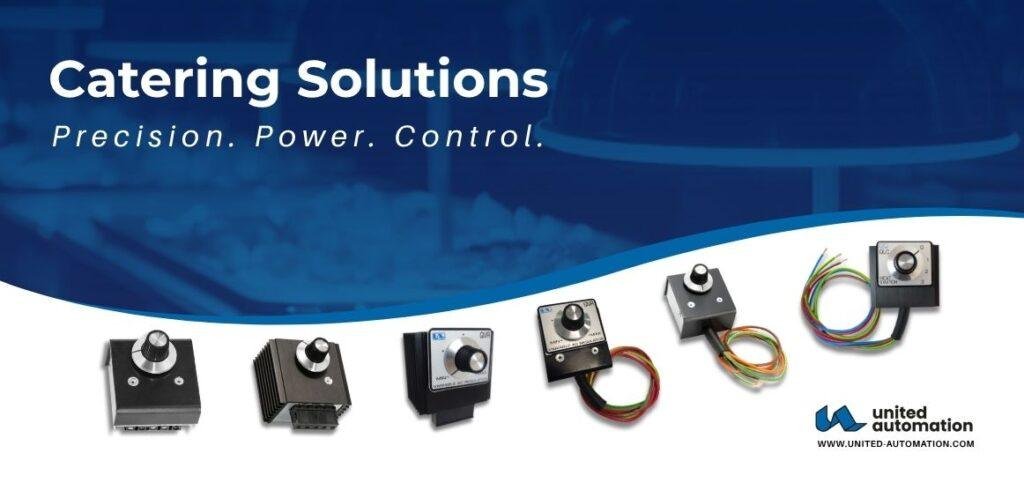
Explore commercial catering controllers and heated gantry dimmer switches from United Automation. Precise phase-angle power regulators for warmers and lamps.
Learn what an Envirostat Frost Protection Controller is, how it works, and why it is essential for protecting external pipework, preventing frozen pipes, improving energy efficiency, and helping reduce the risk of Legionella.
Explore commercial catering controllers and heated gantry dimmer switches from United Automation. Precise phase-angle power regulators for warmers and lamps.
Need a Standard Product or a Bespoke Control System?
Whether you need our proven standard products or a custom control system, United Automation delivers robust and reliable engineering solutions tailored to your industry.
We use cookies on our website to give you the most relevant experience by remembering your preferences and repeat visits. By clicking “Accept All”, you consent to the use of ALL the cookies. However, you may visit "Cookie Settings" to provide a controlled consent.
This website uses cookies to improve your experience while you navigate through the website. Out of these, the cookies that are categorized as necessary are stored on your browser as they are essential for the working of basic functionalities of the website. We also use third-party cookies that help us analyze and understand how you use this website. These cookies will be stored in your browser only with your consent. You also have the option to opt-out of these cookies. But opting out of some of these cookies may affect your browsing experience.
Necessary cookies are absolutely essential for the website to function properly. These cookies ensure basic functionalities and security features of the website, anonymously.
Cookie
Duration
Description
cookielawinfo-checkbox-analytics
11 months
This cookie is set by GDPR Cookie Consent plugin. The cookie is used to store the user consent for the cookies in the category "Analytics".
cookielawinfo-checkbox-analytics
11 months
This cookie is set by GDPR Cookie Consent plugin. The cookie is used to store the user consent for the cookies in the category "Analytics".
cookielawinfo-checkbox-functional
11 months
The cookie is set by GDPR cookie consent to record the user consent for the cookies in the category "Functional".
cookielawinfo-checkbox-functional
11 months
The cookie is set by GDPR cookie consent to record the user consent for the cookies in the category "Functional".
cookielawinfo-checkbox-necessary
11 months
This cookie is set by GDPR Cookie Consent plugin. The cookies is used to store the user consent for the cookies in the category "Necessary".
cookielawinfo-checkbox-necessary
11 months
This cookie is set by GDPR Cookie Consent plugin. The cookies is used to store the user consent for the cookies in the category "Necessary".
cookielawinfo-checkbox-others
11 months
This cookie is set by GDPR Cookie Consent plugin. The cookie is used to store the user consent for the cookies in the category "Other.
cookielawinfo-checkbox-performance
11 months
This cookie is set by GDPR Cookie Consent plugin. The cookie is used to store the user consent for the cookies in the category "Performance".
cookielawinfo-checkbox-performance
11 months
This cookie is set by GDPR Cookie Consent plugin. The cookie is used to store the user consent for the cookies in the category "Performance".
viewed_cookie_policy
11 months
The cookie is set by the GDPR Cookie Consent plugin and is used to store whether or not user has consented to the use of cookies. It does not store any personal data.
viewed_cookie_policy
11 months
The cookie is set by the GDPR Cookie Consent plugin and is used to store whether or not user has consented to the use of cookies. It does not store any personal data.
Functional cookies help to perform certain functionalities like sharing the content of the website on social media platforms, collect feedbacks, and other third-party features.
Performance cookies are used to understand and analyze the key performance indexes of the website which helps in delivering a better user experience for the visitors.
Analytical cookies are used to understand how visitors interact with the website. These cookies help provide information on metrics the number of visitors, bounce rate, traffic source, etc.
Advertisement cookies are used to provide visitors with relevant ads and marketing campaigns. These cookies track visitors across websites and collect information to provide customized ads.


 ) that generate high-frequency radio interference. However, on large loads, rapid block-cycling can induce low-frequency supply fluctuations, flicker, or sub-harmonics governed by standards such as BS EN 61000-3-3. Timebases and multi-zone cycle distribution must be engineered accordingly.