What Are Soft Start Controllers and How Do They Work?
Learn what Soft Start Controllers are, how they work, and why they are essential for protecting electric motors. Discover their benefits, applications, and how they improve energy efficiency.
Table of Contents
Electric motors are at the heart of countless industrial processes, powering pumps, conveyors, compressors, fans, mixers, and manufacturing equipment. However, when a motor starts directly across the line (Direct-On-Line or DOL), it can draw six to ten times its normal operating current, placing significant stress on both the electrical supply and the mechanical equipment it drives.
Soft Start Controllers provide a smarter and more controlled method of starting electric motors. By gradually increasing the voltage supplied to the motor during start-up, they reduce inrush current, minimise mechanical shock, and improve the overall reliability of industrial systems.
Whether you’re designing new equipment or upgrading an existing installation, understanding how Soft Start Controllers work can help improve equipment life, reduce maintenance costs, and increase operational efficiency.
What Are Soft Start Controllers?
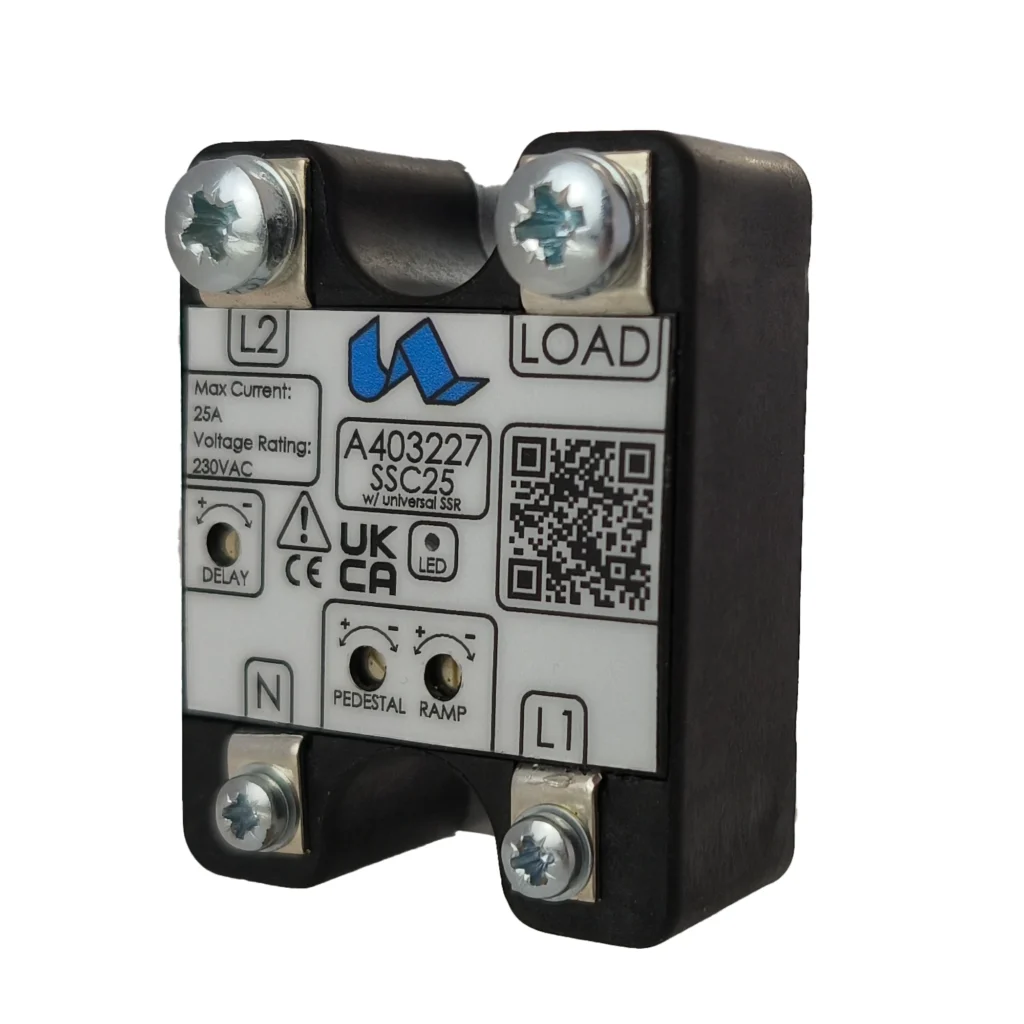
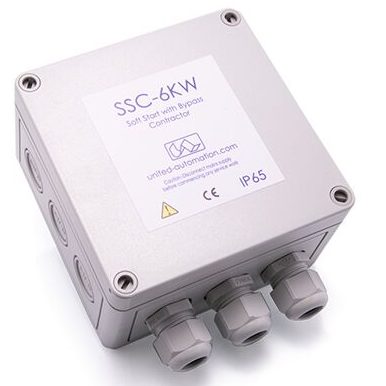
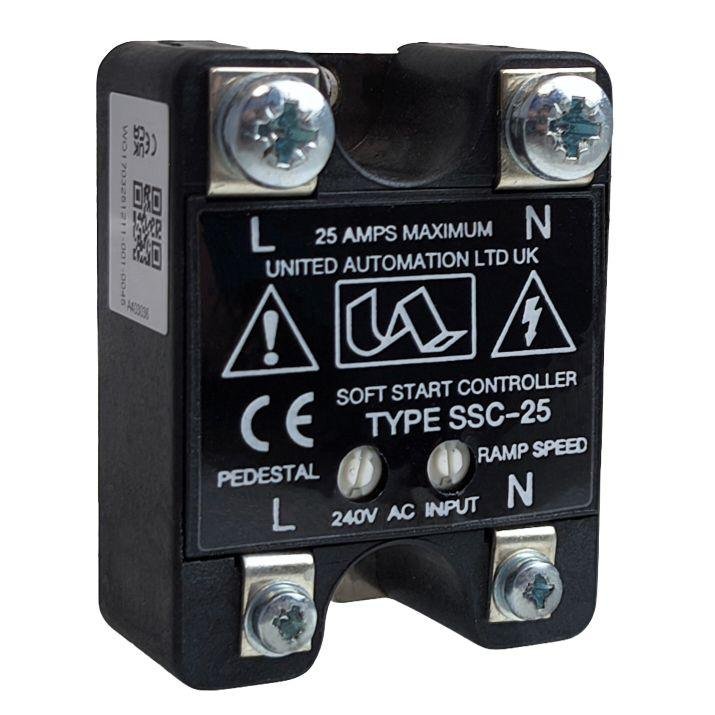
A Soft Start Controller, often referred to as a motor soft starter, is an electronic device that controls the voltage applied to an AC motor during start-up.
Instead of applying full voltage instantly, the controller gradually ramps up the voltage over a predetermined period. This allows the motor to accelerate smoothly until it reaches full operating speed.
Unlike a Variable Frequency Drive (VFD), which changes both voltage and frequency to continuously control motor speed, a Soft Start Controller is primarily designed to manage the starting and stopping process while the motor operates at its normal speed once fully started.
Soft Start Controllers use thyristors (SCRs) connected in each motor phase to control the voltage supplied during start-up.
The controller gradually increases the conduction angle of the SCRs, allowing the motor to receive progressively more voltage until full voltage is reached.
The process typically follows these stages:
1. Initial Start
When the motor receives the start command, the controller supplies a reduced voltage instead of the full mains voltage.
This limits the inrush current while producing enough torque to begin rotating the motor.
2. Controlled Acceleration
The controller gradually increases the output voltage over a preset ramp time.
This allows the motor to accelerate smoothly without sudden mechanical shock.
3. Full Voltage Operation
Once the motor reaches full speed, many Soft Start Controllers automatically engage an internal bypass contactor.
This bypasses the SCRs, reducing heat generation and improving overall efficiency.
4. Soft Stop (Optional)
Some Soft Start Controllers also provide a controlled stopping function.
Instead of stopping abruptly, the controller gradually reduces voltage, preventing water hammer in pumping systems and reducing mechanical stress.
Key Benefits of Soft Start Controllers
1. Reduced Inrush Current
One of the biggest advantages is limiting the high current normally experienced during motor start-up.
Benefits include:
Reduced voltage dips
Improved electrical system stability
Lower peak demand charges
Reduced stress on generators and transformers
2. Longer Equipment Life
Abrupt motor starting can damage:
Bearings
Gearboxes
Belts
Couplings
Drive shafts
Soft Start Controllers reduce mechanical shock, significantly extending equipment life.
3. Lower Maintenance Costs
Reducing mechanical and electrical stress results in:
Fewer breakdowns
Reduced downtime
Lower maintenance costs
Improved production reliability
4. Improved Operational Safety
Smooth acceleration improves operator safety by preventing sudden equipment movement and reducing stress on driven machinery.
5. Energy Efficiency
Although Soft Start Controllers are primarily designed for motor protection rather than speed control, they contribute to energy efficiency by:
Reducing electrical losses during start-up
Lowering peak current demand
Improving overall system performance
Common Industrial Applications
Soft Start Controllers are widely used wherever controlled motor starting is required.
Pumps: prevent water hammer and pressure surges while protecting pumps and pipework.
Fans and HVAC Systems: provide smooth fan acceleration, reducing belt wear and improving ventilation system reliability.
Conveyor Systems: prevent sudden starts that could damage products or mechanical components.
Compressors: reduce mechanical stress and improve compressor lifespan.
Industrial Machinery: ideal for mixers, crushers, mills, woodworking equipment, packaging machinery, and manufacturing systems.
Soft Start Controllers vs Direct-On-Line (DOL) Starting
Feature
Direct-On-Line (DOL)
Soft Start Controllers
Starting Current
Very High
Low
Mechanical Shock
High
Minimal
Motor Protection
Limited
Excellent
Equipment Life
Reduced
Extended
Maintenance Costs
Higher
Lower
Start-up Control
Instant
Smooth
For most industrial applications, Soft Start Controllers offer a safer and more efficient method of motor starting.
Soft Start Controllers vs Variable Frequency Drives (VFDs)
Many engineers ask whether they should use a Soft Start Controller or a Variable Frequency Drive.
Feature
Soft Start Controller
Variable Frequency Drive
Controls Motor Speed
No
Yes
Reduces Inrush Current
Yes
Yes
Continuous Speed Control
No
Yes
Cost
Lower
Higher
Ideal For
Motor starting
Speed control applications
If the application requires the motor to run at a constant speed, a Soft Start Controller is often the most cost-effective solution.
If variable speed operation is required, a VFD is the better choice.
Related Power Control Technologies
Soft Start Controllers are frequently used alongside other industrial power control products, including:
Together, these technologies help engineers design reliable, energy-efficient industrial automation systems.
Conclusion
Soft Start Controllers are an essential component in modern industrial automation, providing a reliable and cost-effective solution for protecting motors and reducing electrical and mechanical stress during start-up.
By gradually increasing motor voltage, they improve equipment lifespan, reduce maintenance costs, minimise inrush current, and enhance overall system reliability.
Whether you’re operating pumps, fans, conveyors, compressors, or manufacturing equipment, investing in the right Soft Start Controller can deliver long-term performance improvements and lower operational costs.
Explore United Automation’s range of Soft Start Controllers to find the ideal solution for your motor control application.
FAQ – Soft Start Controllers
What is the purpose of a Soft Start Controller?
A Soft Start Controller gradually increases the voltage supplied to an electric motor during start-up, reducing inrush current and mechanical stress.
Do Soft Start Controllers save energy?
Their primary purpose is motor protection rather than energy savings. However, by reducing electrical peaks and improving system efficiency, they can contribute to lower operating costs.
Can Soft Start Controllers be used on all motors?
They are most commonly used with three-phase AC induction motors, although some models are suitable for single-phase applications.
What industries use Soft Start Controllers?
They are widely used in: – Manufacturing – Water treatment – HVAC systems – Food processing – Mining – Quarrying – Agriculture – Packaging – Material handling
What is the difference between a Soft Start Controller and a Variable Frequency Drive?
A Soft Start Controller controls only the motor starting and stopping process, whereas a Variable Frequency Drive continuously controls motor speed by varying both voltage and frequency.
Explore commercial catering controllers and heated gantry dimmer switches from United Automation. Precise phase-angle power regulators for warmers and lamps.
Learn what an Envirostat Frost Protection Controller is, how it works, and why it is essential for protecting external pipework, preventing frozen pipes, improving energy efficiency, and helping reduce the risk of Legionella.
Explore commercial catering controllers and heated gantry dimmer switches from United Automation. Precise phase-angle power regulators for warmers and lamps.
Learn what an Envirostat Frost Protection Controller is, how it works, and why it is essential for protecting external pipework, preventing frozen pipes, improving energy efficiency, and helping reduce the risk of Legionella.
Need a Standard Product or a Bespoke Control System?
Whether you need our proven standard products or a custom control system, United Automation delivers robust and reliable engineering solutions tailored to your industry.
We use cookies on our website to give you the most relevant experience by remembering your preferences and repeat visits. By clicking “Accept All”, you consent to the use of ALL the cookies. However, you may visit "Cookie Settings" to provide a controlled consent.
This website uses cookies to improve your experience while you navigate through the website. Out of these, the cookies that are categorized as necessary are stored on your browser as they are essential for the working of basic functionalities of the website. We also use third-party cookies that help us analyze and understand how you use this website. These cookies will be stored in your browser only with your consent. You also have the option to opt-out of these cookies. But opting out of some of these cookies may affect your browsing experience.
Necessary cookies are absolutely essential for the website to function properly. These cookies ensure basic functionalities and security features of the website, anonymously.
Cookie
Duration
Description
cookielawinfo-checkbox-analytics
11 months
This cookie is set by GDPR Cookie Consent plugin. The cookie is used to store the user consent for the cookies in the category "Analytics".
cookielawinfo-checkbox-analytics
11 months
This cookie is set by GDPR Cookie Consent plugin. The cookie is used to store the user consent for the cookies in the category "Analytics".
cookielawinfo-checkbox-functional
11 months
The cookie is set by GDPR cookie consent to record the user consent for the cookies in the category "Functional".
cookielawinfo-checkbox-functional
11 months
The cookie is set by GDPR cookie consent to record the user consent for the cookies in the category "Functional".
cookielawinfo-checkbox-necessary
11 months
This cookie is set by GDPR Cookie Consent plugin. The cookies is used to store the user consent for the cookies in the category "Necessary".
cookielawinfo-checkbox-necessary
11 months
This cookie is set by GDPR Cookie Consent plugin. The cookies is used to store the user consent for the cookies in the category "Necessary".
cookielawinfo-checkbox-others
11 months
This cookie is set by GDPR Cookie Consent plugin. The cookie is used to store the user consent for the cookies in the category "Other.
cookielawinfo-checkbox-performance
11 months
This cookie is set by GDPR Cookie Consent plugin. The cookie is used to store the user consent for the cookies in the category "Performance".
cookielawinfo-checkbox-performance
11 months
This cookie is set by GDPR Cookie Consent plugin. The cookie is used to store the user consent for the cookies in the category "Performance".
viewed_cookie_policy
11 months
The cookie is set by the GDPR Cookie Consent plugin and is used to store whether or not user has consented to the use of cookies. It does not store any personal data.
viewed_cookie_policy
11 months
The cookie is set by the GDPR Cookie Consent plugin and is used to store whether or not user has consented to the use of cookies. It does not store any personal data.
Functional cookies help to perform certain functionalities like sharing the content of the website on social media platforms, collect feedbacks, and other third-party features.
Performance cookies are used to understand and analyze the key performance indexes of the website which helps in delivering a better user experience for the visitors.
Analytical cookies are used to understand how visitors interact with the website. These cookies help provide information on metrics the number of visitors, bounce rate, traffic source, etc.
Advertisement cookies are used to provide visitors with relevant ads and marketing campaigns. These cookies track visitors across websites and collect information to provide customized ads.